Beginner's Guide to Hanging Bunting Without Damaging Walls
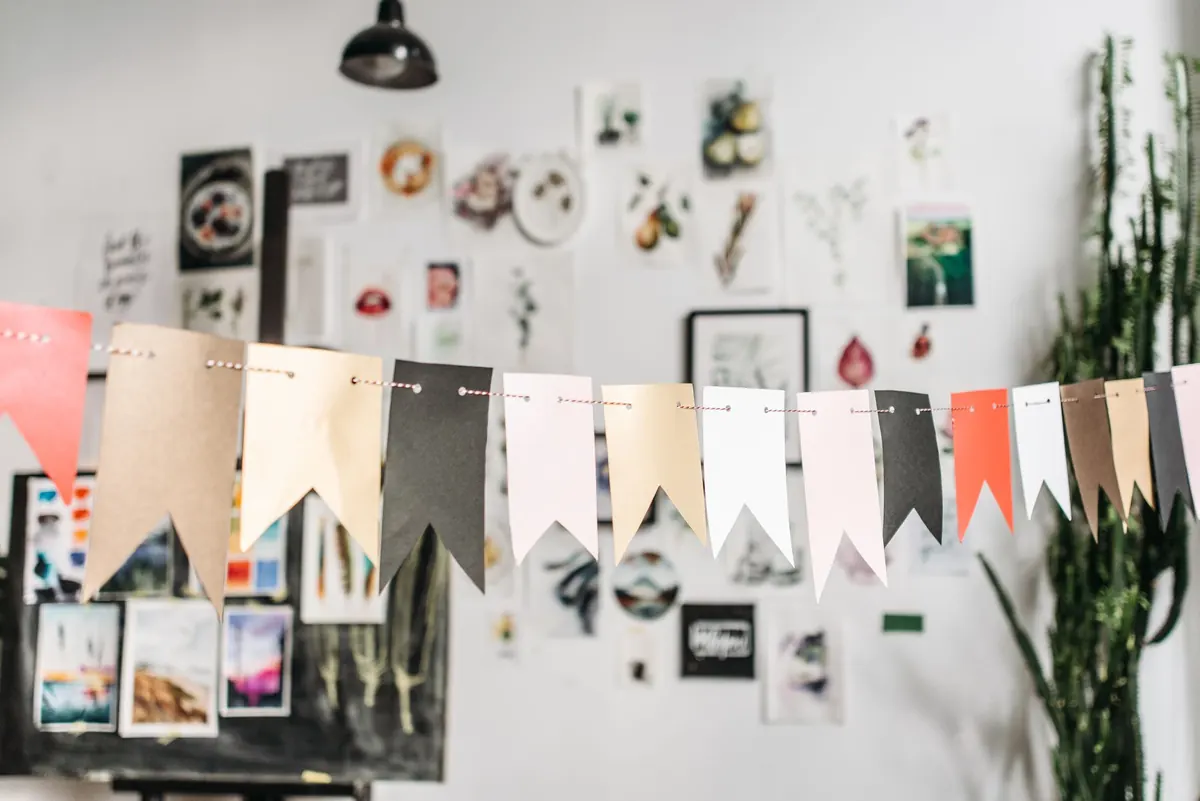
Bunting is the fastest way to make a plain room look like a party. It is also, unfortunately, one of the fastest ways to lose a deposit. A ten-metre run of flags takes twenty minutes to put up and, if you get it wrong, considerably longer to explain to a landlord.
None of that is necessary. Bunting is light, and light things can be hung with surprisingly little commitment. The trick is matching the fixing to the surface underneath and thinking about the takedown at the exact moment you think about the setup.
Read the Surface Before You Stick Anything to It
Every adhesive and hook behaves differently depending on what it is touching. A command strip that holds beautifully on a painted plasterboard wall will peel the paper facing off a cheap flat-pack wardrobe, and it will barely grip a textured render or a brick wall at all.
Useful things to check:
- Fresh paint. Give new paint several weeks to cure before you press anything sticky onto it. Wet paint and adhesive strips are a bad combination.
- Wallpaper and vinyl. Treat these as fragile. Adhesives often lift the seam or the pattern; lean towards tension lines anchored elsewhere.
- Texture. Orange-peel plaster, woodchip, and stucco reduce how much surface an adhesive actually touches. Expect to need more fixings, spaced closer together.
- Loose or flaking paint. If a fingernail lifts the edge, an adhesive strip will take a patch with it. Tape over that spot or avoid it.
If you are unsure, do a patch test. Stick a small piece of tape or a spare adhesive tab in a corner nobody will photograph, leave it for a day, then peel it off slowly. You will learn more in that twenty-four hours than any packaging claim can tell you.
Removable Adhesives and Hooks: The Everyday Option
Removable adhesive strips and hooks are the default for most indoor bunting, and for good reason. They hold a decent amount of weight, they come off with a pull, and they are cheap enough to buy in bulk. Most failures come down to user error rather than the product.
Getting adhesive to hold
Clean the spot with a little rubbing alcohol on a cloth and let it dry. Press the tab or hook firmly against the wall for the full time the instructions suggest — usually thirty seconds of solid pressure, not a polite tap. Then wait. Almost every adhesive hook needs time to bond before it carries weight; hanging the bunting immediately is the single most common reason a strip lets go at 9pm.
Getting adhesive to let go
When it is time to remove a strip, do not pull it straight out from the wall. Follow the tab downwards, slowly, stretching it along the wall rather than away from it. The adhesive stretches and releases as it goes. Rushing this step is how paint comes off in a sheet rather than in one clean motion.
Low-tack tape as a light-duty backup
Painter's tape is fine for very light paper bunting across a short distance, and it is forgiving on painted walls. It is not fine for anything heavy, and it will sag in a warm room. If a run keeps dropping, the answer is a better anchor point, not more tape.
Tension Lines for Long Runs
For anything wider than a doorway, a tension line beats a row of individual hooks. You rig one cord across the room and clip the bunting to it, which means fewer fixings on the wall and a much tidier drape.
The best anchors are things that already exist and are already fixed properly: curtain rod brackets, picture rails, the top of a bookshelf, cabinet handles, a door frame, the corners of a window recess. A line strung between two solid objects puts almost no load on the wall itself.
Use a cord that does not stretch much — cotton string, thin paracord, or garden twine work well. Tie off with a knot you can adjust, such as a taut-line hitch or a simple slip knot, so you can tighten the line without untying everything. Attach bunting with small clips, pegs, or loops of thread so you can slide it along and get the spacing even.
One caution: a tensioned line pulls sideways. If your anchor is a hook that was only designed to hold a picture downward, the sideways load can work it loose. Keep the line gently taut rather than guitar-string tight.
Hooks, Pins, and Other Fixings
Small picture hooks and narrow pins leave tiny holes that are simple to fill later, and they can carry far more than adhesive. They are worth considering if you are allowed to make small holes, or if the wall is your own. On tiled or wood surfaces, a hook with a removable adhesive backing usually does the job without a drill.
What you should avoid on a rented wall: nails you have to hammer hard, screws into plasterboard without a plug, and anything heavy hanging from a single point. Bunting is rarely heavy enough to need them.
Weight, Spacing, and the Sag Problem
Fabric bunting weighs more than paper bunting. Add wooden letters or appliqué and a long run gets noticeably heavier, which means more support points.
As a working rule, give a fabric run a support roughly every metre, and a paper run a little less often. If you notice a dip forming within the first half hour, add a fixing rather than tightening the line, because tightening pulls on the end anchors.
Press or steam the bunting before you hang it. Creases become very visible once the flags are backlit or photographed, and no amount of clever rigging hides a folded triangle.
The Takedown Matters as Much as the Setup
Plan the removal before the party, not after. Give adhesive a little warmth from a hairdryer on a low setting — warm adhesive releases far more cleanly than cold — then peel slowly and keep your fingers close to the wall to support the surrounding paint. Any gummy residue usually comes away with a dab of cooking oil on a cloth, tested first in a hidden spot.
For small pin holes, a touch of filler and a match of paint is normally enough. If you are renting and unsure how the wall should be left, ask your landlord or letting agent before you start patching rather than after.
A Two-Minute Plan That Saves an Afternoon
- Walk the route and note every surface the bunting will touch.
- Pick your anchors — existing hardware first, adhesive second, pins last.
- Test one fixing in a hidden spot and leave it overnight.
- Clean, press, and wait before loading any adhesive.
- Clip the bunting loosely, then adjust spacing and tension.
- Set a phone reminder for the takedown while the room is still tidy.
Do that, and the bunting comes down as quickly as it went up — with nothing left behind but photographs.
Photo: Pavel Danilyuk / Pexels